

Auteur
Jonathan Hobbs, CFA
Date
05 May 2026
Catégorie
Education
The IncomeShares 75/10/15 Multi-Asset Growth ETP explained
Votre capital est exposé à un risque si vous investissez. Vous pouvez perdre la totalité de votre investissement. Veuillez consulter l’avertissement complet sur les risques ici
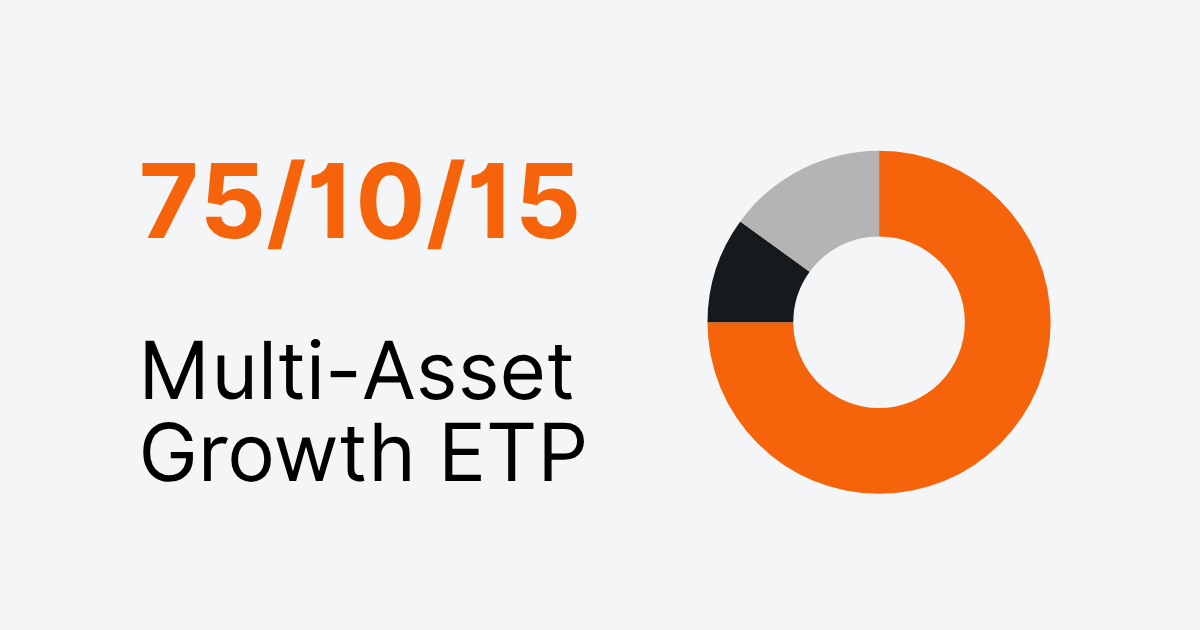
The IncomeShares 75/10/15 Multi-Asset Growth ETP aims to pay monthly income with a focus on long-term growth. It gives investors income and asset price exposure across three asset classes in one product. The 75/10/15 split is 75% stocks, 10% long-dated US Treasuries, and 15% commodities.
It's a more growth-focused alternative to the 60/30/10 Multi-Asset Balanced ETP – with more in stocks, less in bonds, and more in commodities.
This article walks through what the exchange-traded product holds, why we picked the allocation, and how each part aims to generate income.
What the 75/10/15 Multi-Asset Growth ETP holds
The ETP is built like a fund-of-funds. Where possible, it holds other IncomeShares options income ETPs as the building blocks. It may also hold other ETFs directly where that gives the strategy more efficient exposure to a specific asset class or income strategy.
Holdings can shift over time. As with all our baskets, we aim to rebalance every six months – this time back to the 75/10/15 split. That helps stop any single asset class from becoming too dominant within the ETP. Effectively, it means trimming the better-performing positions to top up on the underperformers. This can help manage volatility over time.
The thinking behind the split
We picked this allocation with both growth and income in mind. Each part is there for a reason.
Why 75% in stocks?
Stocks have tended to grow more than bonds or commodities over time. So an allocation focused on growth needs to lean into stocks.
Stocks also tend to be more volatile than other assets – especially growth stocks. That volatility is uncomfortable if you want stable returns, but it may be useful for options income. The bigger the potential price swings, the more option buyers may pay for them.
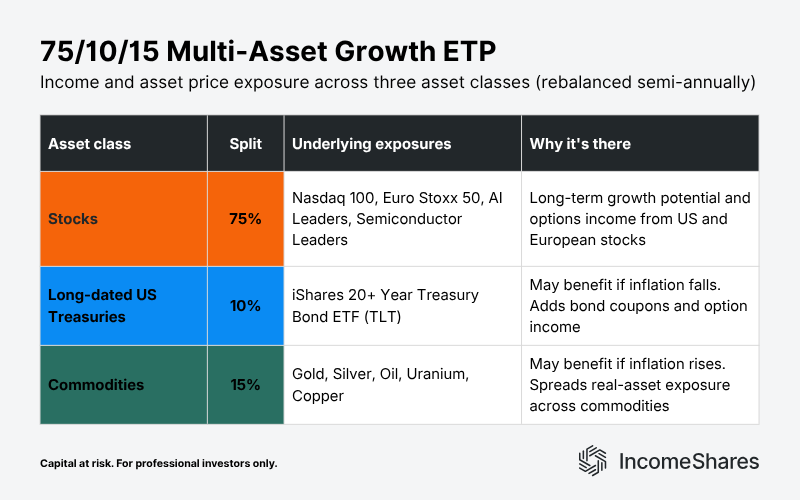
The 75% stock sleeve aims to combine growth potential with geographic diversification – and uses options strategies on those stocks for income potential. The largest weighting goes to US large-cap tech through Nasdaq 100 exposure. European large-caps come next through Euro Stoxx 50 exposure, which adds geographic diversification beyond US holdings. Smaller thematic positions in AI and semiconductor companies aim to add extra income and growth potential. These higher-volatility names typically pay more in option premiums.
Why 10% in long-duration Treasuries?
The bond sleeve is 10% in the IncomeShares 20+ Year Treasury Options ETP (TLTY). TLTY holds the iShares 20+ Year Treasury Bond ETF (TLT) and sells call options on TLT for income potential.
TLT itself holds US government bonds with maturities of 20 years or more, and pays income from bond coupons. So TLTY adds two layers of income potential: bond coupons from TLT and option premiums from the calls sold on it.
There's a macro angle here, too. Long-dated Treasuries pay fixed coupons over many years. If inflation falls, the value of those future coupons gets eroded less – which can make the bonds more attractive. AI could play into this. If it makes things cheaper to produce or weighs on the job market, inflation could fall further. Central banks may also cut rates in that scenario, which tends to push long-dated Treasury prices higher.
Historically, Long-dated Treasuries have moved differently to stocks and commodities during risk-off periods. That can make them useful for diversification within a multi-asset portfolio.
Long-dated Treasuries are down roughly 40% from their 2020 peak. That may make long duration a more attractive entry point today.
Why 15% across five commodity themes?
Commodities don't pay income on their own. So options strategies are one of the few ways to potentially turn commodity-linked exposure into yield.
Commodities are also there for a different macro scenario than long-dated Treasuries. Where TLTY may benefit if inflation falls, commodities may benefit if inflation rises. Real assets like silver, oil, and copper feed into the cost of goods, while gold has historically been an inflation hedge. Either way, commodity exposure might hold up if inflation rises, while bonds may struggle.
The 15% allocation spreads across five commodity themes:
Gold – the classic safe haven and potential inflation hedge.
Silver – a precious metal with monetary and industrial use.
Oil – energy exposure tied to geopolitical and supply factors.
Uranium – linked to nuclear power demand, including from data centres.
Copper – industrial metal exposure tied to electrification and grid investment.
Spreading 15% across five themes may reduce the risk of any single one having an outsized impact – while keeping the diversification and income benefits of commodity exposure.
The 75/10/15 Multi-Asset Growth ETP trades on the London Stock Exchange in USD (GRWY) and GBP (GRWI), with planned cross-listings in Europe soon.
Three things to remember
The IncomeShares 75/10/15 Multi-Asset Growth ETP gives investors income and asset price exposure across stocks, long-dated US Treasuries, and commodity-linked companies and assets in one product.
The allocation is designed for two macro scenarios. The TLTY sleeve may benefit if inflation falls. The commodity sleeve may benefit if inflation rises. The stock sleeve aims to drive long-term growth and income across both.
We aim to rebalance the ETP every six months back to the 75/10/15 split to help manage volatility.
Votre capital est exposé à un risque si vous investissez. Vous pouvez perdre la totalité de votre investissement. Veuillez consulter l’avertissement complet sur les risques ici
Produits associé:

Stratégie
Option de vente couverte par liquidités + actions
Rendement des
distributions
43.25%

Stratégie
Covered call
Rendement des
distributions
12.81%

Stratégie
Covered Call
Rendement des
distributions
12.21%

Stratégie
Covered Call
Rendement des
distributions
12.82%

Stratégie
Stratégie de revenus basée sur les options
Rendement des
distributions
21.42%

Stratégie
Stratégie de revenus basée sur les options
Rendement des
distributions
75.66%

Stratégie
Stratégie de revenus basée sur les options
Rendement des
distributions
66.53%

Stratégie
Put garanti par des liquidités + Actions
Rendement des
distributions
35.57%

Stratégie
Stratégie de revenus basée sur les options
Rendement des
distributions
36.20%

Stratégie
Put garanti par des liquidités + Actions
Rendement des
distributions
13.58%

Stratégie
Put garanti par des liquidités + Actions
Rendement des
distributions
79.16%