

Autor
Jonathan Hobbs, CFA
Fecha
01 Apr 2026
Categoría
Education
Passive Income Investing: How Options Income ETPs Compare
Su capital está en riesgo si invierte. Podría perder toda su inversión. Por favor, consulte la advertencia de riesgos completa aquí.
There are different ways to generate passive income from investing – and each approach has benefits and drawbacks. This article covers three traditional income-generating investments: dividend stocks, bonds, and real estate. We'll then compare those with options income ETPs to see how they stack up.
Passive income from dividend stocks
Dividends come from company earnings. Companies that pay them consistently tend to be mature, stable businesses – like utilities, financials, and consumer staples.
But growth stocks typically pay little or no dividends. Instead, they tend to reinvest profits back into their businesses to fuel future growth. Big tech names like Nvidia, Apple, Alphabet, and Microsoft make up a large portion of the US stock market.
That means simply “owning the index” doesn’t provide investors with much dividend income. The chart below shows how the dividend yield of the S&P 500 has trended lower over time.
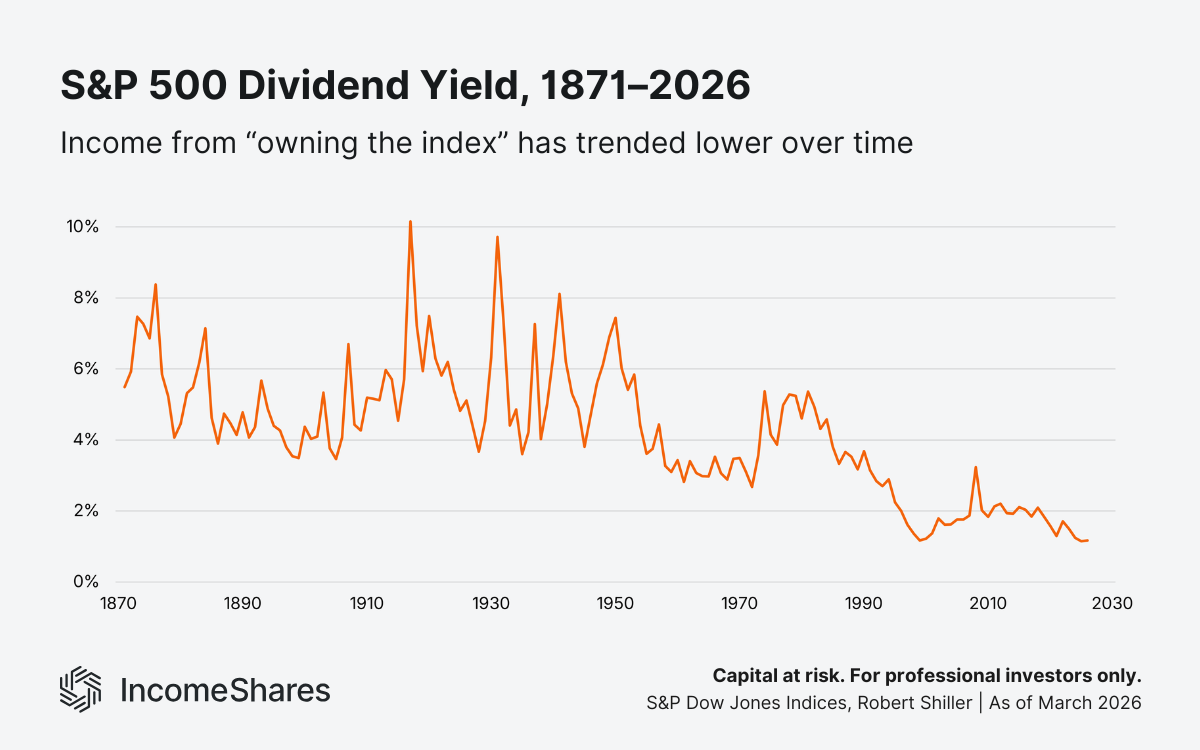
This implies that if investors want more dividend income from stocks, they need to take a more active approach. And that could mean holding fewer growth stocks as a percentage of their stock holdings.
Passive income from bonds
A bond is essentially a loan to a government, company, or other entity. They can provide income through regular interest payments – called coupons – which can be fixed or variable depending on the bond.
One potential risk with bonds as a passive income source is interest rate sensitivity. Bond prices and interest rates typically move in opposite directions. When interest rates rise, the value of existing bonds can fall. The longer the bond has until it matures, the bigger that price move can be.
An investor holding longer-dated bonds could find that capital losses offset income payments if interest rates turn against them.
Government bond yields are generally higher today than they were for most of the past two decades. But many investors are uncertain about where interest rates go from here. Holding bonds for passive income means accepting that risk as part of the deal.
Passive income from real estate
Property owners can earn rental income, but this isn't always “passive”. Owning property can involve management, maintenance, and tenancy issues. Property also tends to be less liquid than other investments – you can't always sell it quickly if you need cash.
Listed real estate investment trusts (REITs) – funds that own properties and trade on a stock exchange – can reduce some of those problems. They must distribute most of their income as dividends.
But REITs typically use borrowing to help finance property purchases. That makes them sensitive to interest rates, partly because borrowing costs rise and future income becomes less attractive. When rates rise, REIT valuations tend to fall. The income may stay intact, but the value of your holding can take a hit.
REITs are more accessible than direct ownership. But they don't fully solve the rate sensitivity problem.
How options income ETPs compare
Options income ETPs generate income by selling options on an underlying asset. When you sell an option, the buyer pays you an upfront fee – called a premium. The ETP collects those premiums and aims to distribute them to investors as monthly income.
That income isn't tied to company earnings, bond coupons, or rental contracts. It's driven by market volatility – the degree to which an asset's price moves around.
Options income strategies can also potentially generate income from assets that pay nothing on their own. That includes growth stocks that pay no dividends, and commodities like gold and silver that offer no yield at all.
Options income ETPs may offer higher yields than traditional income sources like dividend stocks, bonds, and REITs. That's because option premiums – especially on volatile assets – can be high.
But as with any income strategy, there are trade-offs. Upside may be capped, downside isn't removed, and income can fluctuate with market conditions.
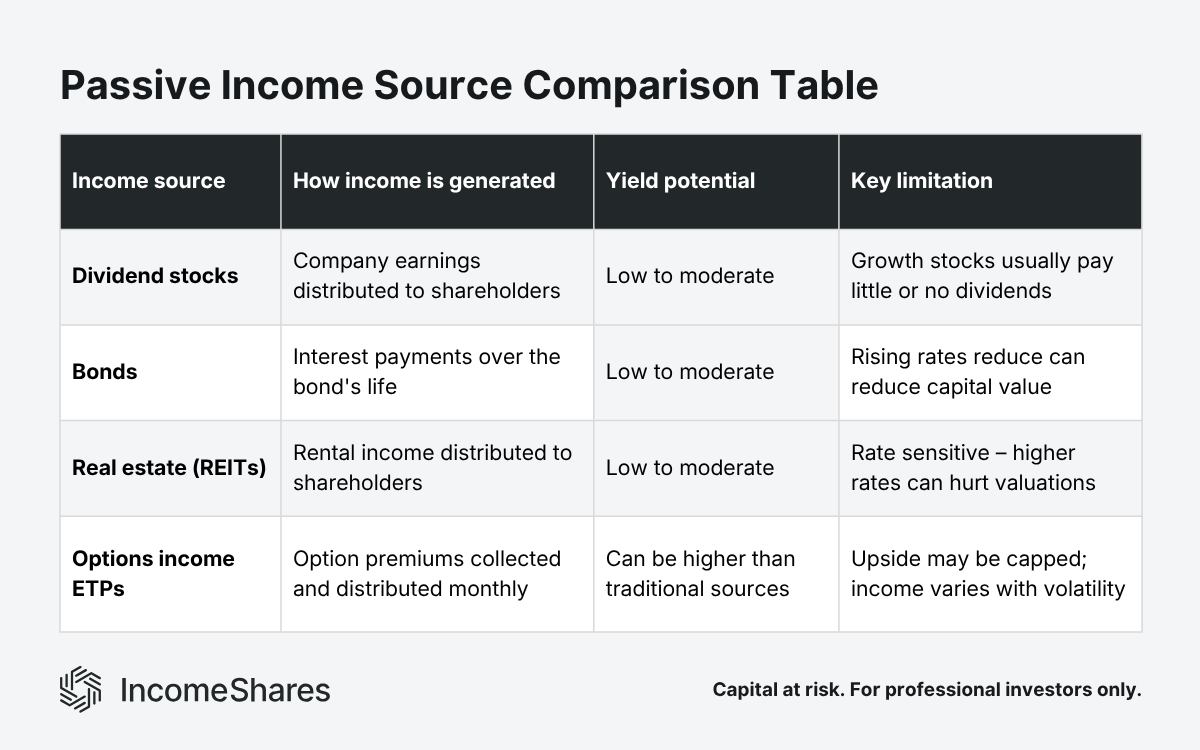
The table below sets out how the four approaches compare.
Three things to remember
Growth stocks tend to pay little in dividends, bonds are sensitive to interest rate moves, and property ownership isn’t always passive. Every traditional approach to passive income investing has a drawback.
Options income ETPs aim to generate yield by selling options on underlying assets. That income is driven by market volatility rather than interest rates – and can potentially come from assets that pay little or nothing on their own.
As with any income strategy, there are trade-offs. Always check total return alongside yield – income received can tell a very different story from price return alone.
Su capital está en riesgo si invierte. Podría perder toda su inversión. Por favor, consulte la advertencia de riesgos completa aquí.
Productos Relacionados:

Estrategia
Put garantizado con efectivo + Acciones
Rendimiento de
Distribución
38.24%

Estrategia
Covered Call
Rendimiento de
Distribución
12.17%

Estrategia
Basket of Income-generating ETPs
Rendimiento de
Distribución
32.98%

Estrategia
Covered Call
Rendimiento de
Distribución
12.17%

Estrategia
Covered Call
Rendimiento de
Distribución
12.26%

Estrategia
Estrategia de ingresos basada en opciones
Rendimiento de
Distribución
22.51%