

Auteur
Jonathan Hobbs, CFA
Date
06 Feb 2026
Catégorie
Market Insights
Reverse Stock Splits Explained For Options Income ETPs
Votre capital est exposé à un risque si vous investissez. Vous pouvez perdre la totalité de votre investissement. Veuillez consulter l’avertissement complet sur les risques ici
Some of the most common questions we get around options income ETPs have nothing to do with options or income. They’re about price. When an ETP’s net asset value falls, investors may wonder whether it might undergo a reverse stock split. That question tends to come up more often in products linked to volatile underlying stocks. These may pay higher income because of that volatility, but NAV erosion can also be greater.
This article explains why those moves happen – and how reverse stock splits could affect options ETPs in theory.
Note: This article is a general explanation of how reverse stock splits work, not an indication that one is planned or expected.
Example: IncomeShares MicroStrategy Options ETP
Some single-stock options ETPs can see more NAV erosion during market drawdowns – especially if they hold “high beta” stocks. That’s mainly down to two reasons:
First, their underlying stock holdings can drop in value, causing the NAV to come down.
Second, the income generated from selling options on volatile stocks may be higher. When the ETP pays out that income to shareholders, it reduces the NAV further.
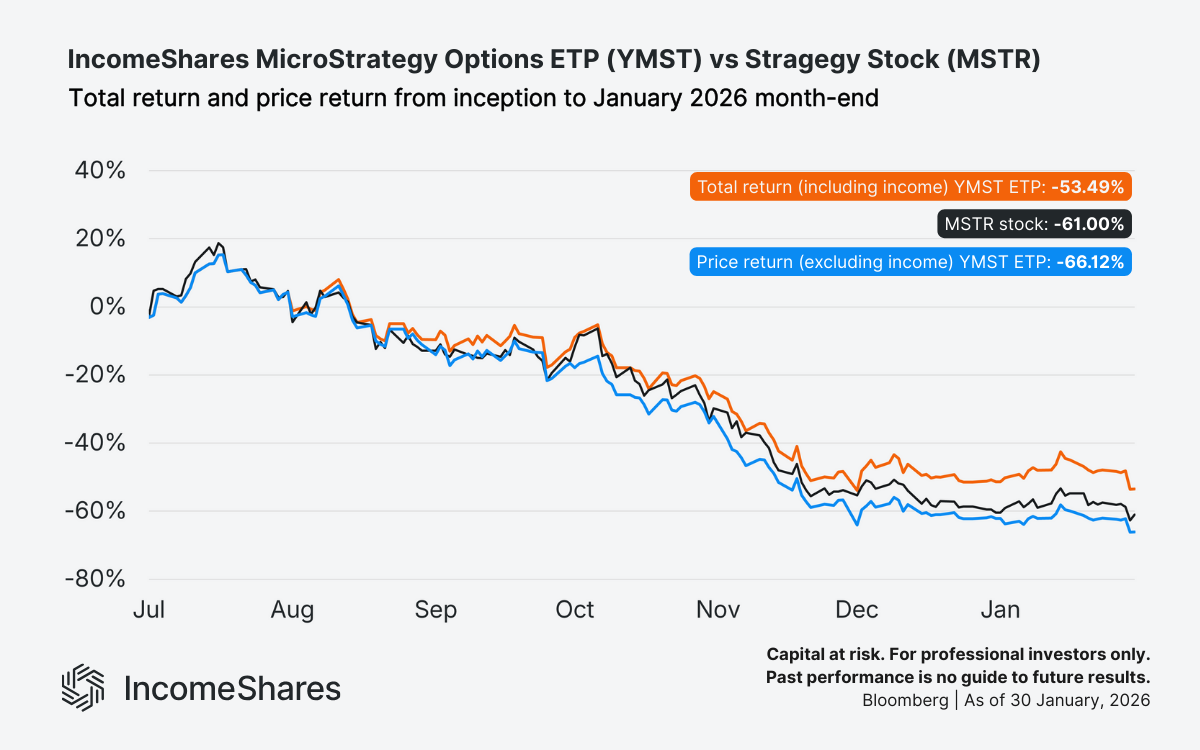
Take Strategy (formerly MicroStrategy) as an example. We launched our IncomeShares MicroStrategy Options ETP (YMST) on 27 June 2025. The ETP holds Strategy shares (MSTR) and sells put options on MSTR for income potential.
All data from the chart below is sourced from Bloomberg. From launch date through to the end of January, the MSTR stock price dropped 61.0% (black line, chart). In that time, the NAV of our YMST product fell 66.1% (blue line). YMST paid out an average annualised distribution yield of 67.2% over that period – or 9.6% per month on average. Those income payments also reduced the ETP’s NAV.
But if we assume the investor reinvested any income back into the ETP each month, their total return would be -53.9% (orange line). It still dropped considerably, but outperformed the underlying stock on a total return basis.
What’s a reverse stock split, and why does it happen?
If a company’s share price falls too low, it may carry out a reverse stock split to lift its stock price. For example, in a 10-for-1 reverse split, ten shares priced at $1 become one share priced at $10. The number of shares changes, but the overall value of the investment stays the same.
The same logic applies to exchange-traded products. If an ETP’s NAV were to keep falling, it could undergo a reverse stock split to increase its NAV per share (or “price”). That would reduce the number of ETP shares available, with each share having a higher price.
How would a reverse stock split affect income ETP investors?
A reverse stock split wouldn’t change an investor’s economic position. The total value of their holding would stay the same. Their number of ETP shares would fall, and the NAV per share would rise by the same proportion. The ETP’s strategy, exposure, risks, and income-generation process would remain unchanged.
A reverse stock split would simply repackage the existing NAV into fewer shares at a higher price. What ultimately matters for investors is total return over time – not the absolute price of each ETP share.
Key takeaways
A falling ETP price reflects changes in the NAV and income paid out, not a change in the underlying strategy.
Reverse stock splits adjust the number of ETP shares and the NAV per share, but don’t change an investor’s economic exposure.
For income ETPs, total return over time – income received plus NAV movement – matters more than the absolute share price.
Votre capital est exposé à un risque si vous investissez. Vous pouvez perdre la totalité de votre investissement. Veuillez consulter l’avertissement complet sur les risques ici
Produits associé:

Stratégie
Option de vente couverte par liquidités + actions
Rendement des
distributions
119.75%

Stratégie
Option de vente couverte par liquidités + actions
Rendement des
distributions
23.49%

Stratégie
Option de vente couverte par liquidités + actions
Rendement des
distributions
42.38%

Stratégie
Option de vente couverte par liquidités + actions
Rendement des
distributions
27.09%