

Autor
Jonathan Hobbs, CFA
Fecha
16 Sep 2026
Categoría
Education
Money Market Funds vs Options Income ETPs: Yield and Risk
Su capital está en riesgo si invierte. Podría perder toda su inversión. Por favor, consulte la advertencia de riesgos completa aquí.
US money market funds held a record $7.98 trillion in September, according to the Investment Company Institute. A money market fund holds short-dated government and bank debt, so it typically pays close to central bank rates. IncomeShares exchange-traded products (ETPs) aim to pay a potentially higher monthly income than those funds. They also carry risks that money market funds don't have.
This article explains what money market funds pay today in the UK, Europe, and the US. It then looks at what an options income ETP could ask you to give up for that higher income potential.
What money market funds pay today
What a money market fund pays depends on the policy rate – the interest rate a central bank sets. When the central bank changes that rate, a money market fund's yield tends to follow within weeks. That’s because the fund holds debt that matures quickly, and it reinvests at the new rate each time.
In the US, the Federal Reserve's policy rate is a range of 3.50% to 3.75%. It decides again on 16 September, and markets expect a rise, according to CME FedWatch. The Vanguard Treasury Money Market Fund, for example, paid 3.70% on 8 September.
In the UK, the Bank of England's policy rate is currently 3.75%. And per interactive investor, sterling money market funds pay 3.7% to 4.1%. The Bank of England next sets its policy rate on 17 September.
In Europe, the European Central Bank (ECB) raised its policy rate to 2.50% on 10 September. So euro money market funds pay around 2.5%.
Money market funds have two clear strengths. The price of the fund's shares barely moves, so your capital tends to stay roughly the same. And the income follows the policy rate, so you have a good idea of what to expect each month.
They also have two weaknesses. Their income can fall with interest rates, since the fund's yield follows the policy rate. And that yield may barely beat inflation. The real interest rate is the policy rate minus inflation, and it shows what an investor actually earns. US inflation was 3.4% in August, according to the Bureau of Labor Statistics, so a 3.7% yield may leave a real return of about 0.3%. UK and European inflation are both around 3%, so real returns there are similar or lower.
How options income ETPs differ from money market funds
Our ETPs hold an underlying asset (like gold or stocks) and sell options on it. The buyer of each option pays us a fee up front, called a premium. Our ETPs aim to fund monthly income distributions from those premiums. The table below sets out the main differences from a money market fund.
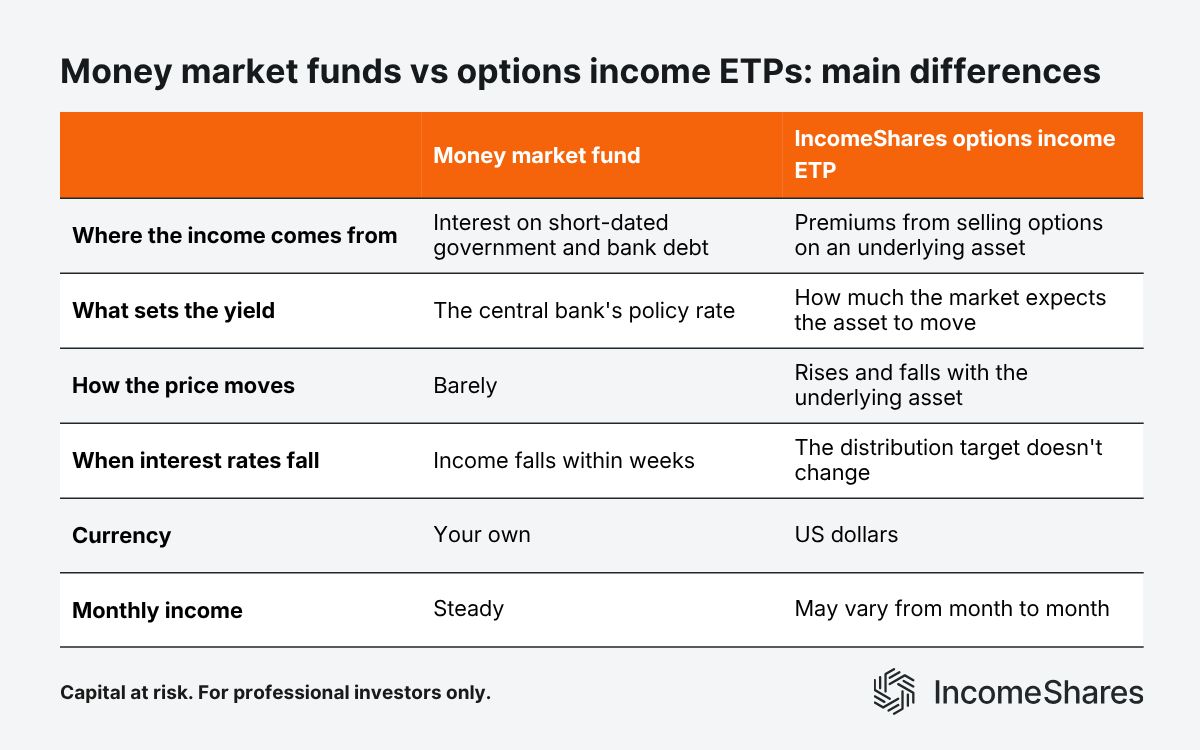
Money market fund vs 20+ Year Treasury Options ETP: total returns
The fair test is total return, which counts the change in price plus every income distribution reinvested when paid. We calculate it from daily Bloomberg price data. All figures below are in US dollars and cover the twelve months to 28 August 2026.
The Vanguard Treasury Money Market Fund returned about 3.8% over that period, or around $380 on $10,000. Its price didn't move, since the fund maintains a $1 share price.
The IncomeShares 20+ Year Treasury Options ETP (TLTY) holds the iShares 20+ Year Treasury Bond ETF (TLT) and sells call options on it. The ETP paid an average annualised distribution yield of 11.9% (about $1,190 on $10,000 invested). Its total return was 1.0%, and its largest fall over the period was 6.28%. The bond ETF itself returned minus 0.6% and paid around 4.6% in coupons. The chart below shows how the two compared.
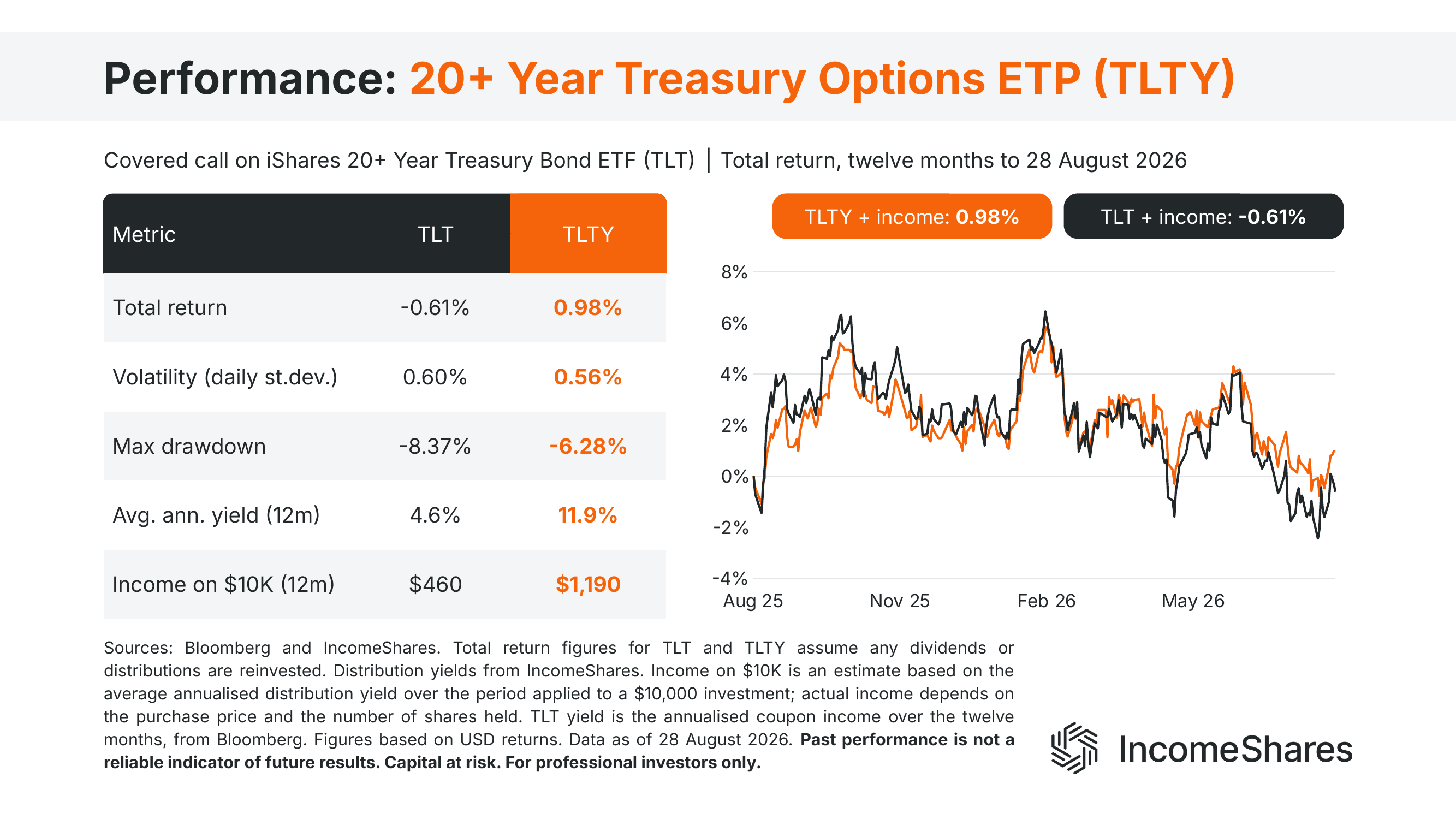
One ETP over twelve months doesn't tell you what the strategy could do next. Only total return shows whether the swings in value paid off.
Key highlights
Money market funds pay close to the central bank's policy rate, so the income can fall when rates fall.
Options income ETPs aim to fund monthly distributions from option premiums, which depend on volatility, not interest rates.
The potentially higher yield comes with a price that moves with the asset, currency risk, and variable income.
Su capital está en riesgo si invierte. Podría perder toda su inversión. Por favor, consulte la advertencia de riesgos completa aquí.
Productos Relacionados:

Estrategia
Covered Call
Rendimiento de
Distribución
12.36%