

Author
Jonathan Hobbs, CFA
Date
27 Nov 2024
Category
Market Insights
Delta Explained: A Simple Guide For Options Traders
Your capital is at risk if you invest. You could lose all your investment. Please see the full risk warning here.
Delta is a key concept in options trading, and it’s simpler than it sounds. It’s the price sensitivity of an option – how much the option value changes with the price of the underlying investment. In this guide, we’ll explain how Delta works, and why it matters for options traders.
What Exactly is Delta in Options?
The word Delta comes from the Greek letter Δ, which is used in math to mean “change”. And in options trading, Delta tells you how sensitive an option’s price is to changes in the underlying investment (like stocks or gold).
Here’s how Delta works for call and put options:
Call options: Delta ranges between 0 and 1. For example, a Delta of 0.5 means that if the stock price goes up by $1, the call option’s price will rise by about $0.50. The closer the Delta is to 1, the more the option’s price will behave like the underlying stock.
Put options: Delta ranges between -1 and 0. A Delta of -0.5 means that if the stock price goes up by $1, the put option’s price will drop by about $0.50. The negative sign shows that puts typically lose value when the stock price goes up (since they’re a bet that the price will go down).
Think of Delta as a “speedometer” for your option’s price. The higher the Delta, the faster it reacts to price changes in the underlying investment of the option.
Why Does Delta Matter For Options Traders?
Delta is important for a few reasons:
Tracking options prices: Delta gives a rough idea of how much your option might change in value if the stock price moves.
Assessing risk and potential profit: The higher the Delta, the more sensitive the option is to changes in the stock price. Options with a high Delta (close to 1 or -1) are riskier but could offer higher potential rewards.
Hedging and strategy: Delta can help balance your portfolio. If you own stock and want to hedge against potential losses, you could buy put options with a negative Delta. This would partially offset a drop in the stock’s value.
How Delta Changes Over Time: The Impact of “Moneyness”
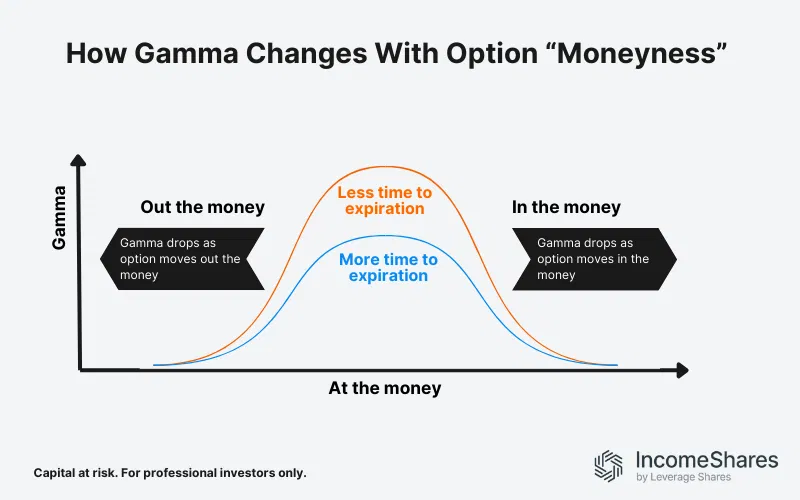
Delta values aren’t fixed – they change as the stock price moves and the option’s expiration date gets closer. Here’s how:
At-the-money (ATM): If the option’s strike price is close to the current stock price, the Delta is usually around 0.5 for calls and -0.5 for puts. This means the option has a decent chance of moving in or out of profitability (or “moneyness”).
In-the-money (ITM): If the option’s strike price is below the stock price (for calls) or above it (for puts), the Delta moves closer to 1 (or -1 for puts). Here, the option has a high probability of finishing “in the money”. That means it’s likely to be profitable if the stock doesn’t drop sharply (or rise for puts).
Out-of-the-money (OTM): If the option’s strike price is far from the current stock price, the Delta will be low (i.e. closer to 0). That’s because the option is unlikely to end up in the money. In other words, its price is less sensitive to stock movements.
Bottom line: Delta becomes more sensitive to stock price movements as expiration approaches – especially for at-the-money options.
Call Option Example
You own a call option on a stock with a Delta of 0.6. If the stock price goes up by $1, your option price would likely increase by about $0.60. But if the option’s Delta changes as the stock price rises, it might be closer to 0.8. That would mean the option is now more responsive to stock price changes.
For put options, imagine you have a Delta of -0.4. If the stock price increases by $1, your option’s price would drop by about $0.40. If the stock drops, the negative Delta means the option’s price will increase.
Key Takeaways
- Delta measures how much an option’s price changes with a $1 change in the stock price (or the price of any underlying investment).
- Call options have positive Delta (0 to 1), and put options have negative Delta (0 to -1).
- Higher Deltas mean the option is more responsive to stock price changes. Lower Deltas (closer to zero) mean less sensitivity.
Your capital is at risk if you invest. You could lose all your investment. Please see the full risk warning here.
Related Products:

Strategie
Barbesicherte Puts + Eigenkapital
Ausschüttungsrendite
52.79%

Strategie
Barbesicherte Puts + Eigenkapital
Ausschüttungsrendite
45.74%

Strategie
Barbesicherte Puts + Eigenkapital
Ausschüttungsrendite
51.22%

Strategie
Barbesicherte Puts + Eigenkapital
Ausschüttungsrendite
26.95%

Strategie
Covered Call
Ausschüttungsrendite
12.69%