

Author
Jonathan Hobbs, CFA
Date
07 Mar 2025
Category
Market Insights
Dividend Income vs. Options ETP Income: What’s the Difference?
Your capital is at risk if you invest. You could lose all your investment. Please see the full risk warning here.
Dividend stocks and options-based ETPs (exchange-traded products) may both generate income, but they work in very different ways. Investors seeking yield need to understand the trade-offs between the two. This guide breaks down how dividend income and options ETP income work, their key differences, and what investors should consider.
What is dividend income?
Dividend income comes from company profits. Some companies, especially mature businesses with steady cash flows, distribute a portion of their earnings to shareholders. These payments are typically made every quarter, though some companies pay them monthly or annually.
Dividend payouts are not guaranteed. A company’s board decides whether to maintain, increase, or cut dividends based on business performance and financial priorities. Economic downturns, industry challenges, or cash flow constraints may lead to dividend reductions or suspensions.
What is options ETP income?
Options ETP income comes from selling options contracts to collect premium payments within an ETP. These ETPs may use strategies like covered calls or cash-secured puts. Unlike dividends, which are tied to a company’s profitability, options ETP income depends on market conditions, volatility, and the ETP’s strategy.
Key differences between dividend and options ETP income
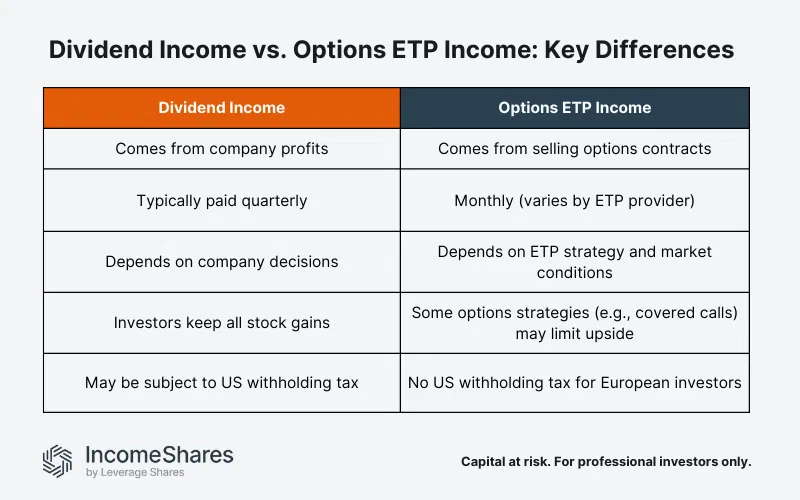
Both dividend and options-based strategies may provide income, but they have different risk-reward dynamics.
- Income source: Dividends come from company profits, while options ETPs generate income from selling options contracts.
- Payout frequency: Dividends are typically paid quarterly, while IncomeShares options ETPs aim to pay out a monthly distribution yield.
- Risk factors: Dividend income depends on company decisions, while options ETP income depends on market conditions.
- Upside potential: Dividend investors keep all stock gains, while some options strategies (e.g., covered calls) may limit upside.
- Tax treatment: Dividends may be subject to US withholding tax, while options ETPs may offer more efficient tax treatment for European investors.
For income investors, understanding these differences is crucial. Each approach has advantages, and the right choice depends on an investor’s risk tolerance, tax situation, and financial goals.
Key takeaways
- Dividend income is tied to company profits and board decisions.
- Options ETP income depends on market conditions and contract pricing.
- Options-based ETPs may provide a tax-efficient alternative for European investors compared to US dividend stocks.
Your capital is at risk if you invest. You could lose all your investment. Please see the full risk warning here.
Related Products:

Strategie
Barbesicherte Puts + Eigenkapital
Ausschüttungsrendite
88.74%

Strategie
Barbesicherte Puts + Eigenkapital
Ausschüttungsrendite
39.56%

Strategie
Barbesicherte Puts + Eigenkapital
Ausschüttungsrendite
28.84%

Strategie
Covered Call
Ausschüttungsrendite
12.15%