

Author
Jonathan Hobbs, CFA
Date
02 Dec 2024
Category
Market Insights
Cash-Secured Put Options Explained: A Simple Guide
Your capital is at risk if you invest. You could lose all your investment. Please see the full risk warning here.
When it comes to options strategies, cash-secured put options are a widely used choice. This strategy can appeal to investors looking to generate income or potentially buy stocks at an effective discount. In this guide, we’ll outline what cash-secured puts are, how they work, and why they might appeal to certain investors.
What is a cash-secured put?
A cash-secured put is a defensive options strategy that can also generate income. In this strategy, you sell a put option on a stock (or other underlying investment) to earn income from the option premium. With put options, the buyer will exercise the option if the stock price drops below the strike price. As the put option seller, you’d be obligated to buy the stock at the strike price.
And that’s where the “cash-secured” part comes in. It means you hold enough cash to buy the stock if the price moves against you—and the buyer exercises the put option.
The premium you collect when selling the put helps offset the cost of buying the stock. This strategy may be attractive to investors who are seeking to generate income while potentially buying stocks at an effective discount.
Example: Cash-secured put on the Nasdaq 100
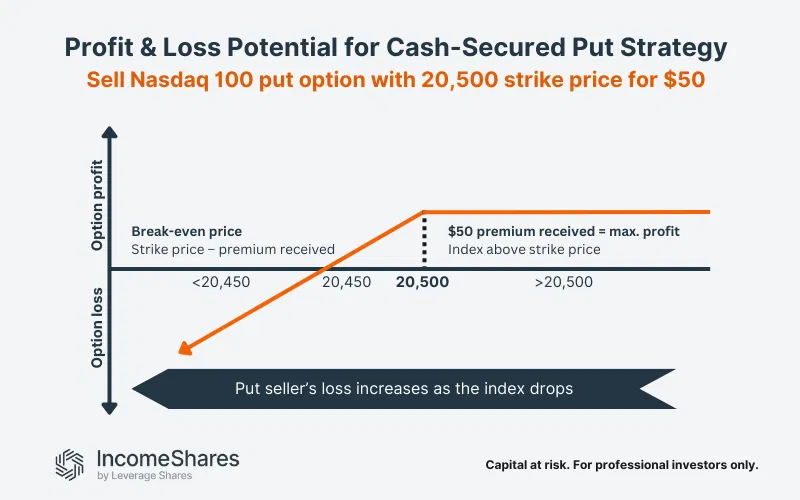
Suppose the Nasdaq 100 index is trading at 20,800. As part of a cash-secured put strategy, you sell a put option with a strike price of 20,500 for a premium of $50 per contract. Here’s how it could play out:
Scenario 1: The Nasdaq 100 stays above 20,500. The put option expires worthless because the buyer has no incentive to exercise it. You keep the $50 premium as income, and your cash stays put.
Scenario 2: The Nasdaq 100 drops below 20,500. The option buyer exercises the put, so you’re obligated to buy the Nasdaq 100 at the strike price of 20,500. Since you already earned the $50 premium, you offset part of the cost. So, your net purchase price is 20,450.
Scenario 3: The Nasdaq 100 drops significantly below 20,500. If the index falls much more—say, to 19,000—you would still be required to buy it at the strike price of 20,500. While the $50 premium reduces your cost slightly, your effective purchase price (20,450) is still much higher than the current market value (19,000). This means you’re sitting on a big unrealized loss.
Why use cash-secured put options?
Cash-secured put options might appeal to investors for three main reasons:
Income Generation: You collect a premium upfront when you sell the put option. This provides income no matter what happens to the stock price.
Buying at a discount: If the stock price drops below the strike price, the option buyer might choose to exercise the option. This means you’re “assigned” the stock – you have to buy it at the agreed strike price. But the premium you collected reduces your net cost, so you’re effectively buying the stock at a discount.
Managing risk: Your potential losses are limited to the cash you’ve set aside to buy the stock. This can make the strategy suitable for more cautious investors.
How cash-secured puts fit into options ETPs
Cash-secured puts can also be used within options-based exchange-traded products (ETPs) to generate income. For example, some ETPs sell 0DTE (zero days to expiration) put options to collect premiums while managing risks with cash-secured strategies.
These products typically aim to capitalize on the rapid time decay of options close to expiration, offering consistent income potential. If you’re interested in learning more, check out our guide to 0DTE put-write strategies.
Key takeaways
- A cash-secured put option involves selling a put option while setting aside cash to buy the stock at the strike price if needed.
- The strategy can generate income from premiums and may reduce the net cost of purchasing stocks.
- Cash-secured puts can be incorporated into options ETPs for income genera
Your capital is at risk if you invest. You could lose all your investment. Please see the full risk warning here.
Related Products:

Strategie
Barbesicherte Puts + Eigenkapital
Ausschüttungsrendite
39.92%

Strategie
Barbesicherte Puts + Eigenkapital
Ausschüttungsrendite
28.96%