

Auteur
Violeta Todorova
Date
14 Jan 2026
Catégorie
Market Insights
Gold and Silver Outlook for 2026
Votre capital est exposé à un risque si vous investissez. Vous pouvez perdre la totalité de votre investissement. Veuillez consulter l’avertissement complet sur les risques ici
The Golden Era for Gold is Not Over
Gold delivered one of its best performances in 2025, rising more than 67% and emerging as one of the top-performing asset classes of the year. This exceptional rally was fuelled by a potent combination of heightened geopolitical risk, persistent economic uncertainty, a weaker US dollar, declining real yields, and a renewed wave of investor and central bank demand.
Looking ahead to 2026, the question is whether gold can sustain another year of outsized gains, and whether the structural drivers behind the rally remain intact. In our view, they do. While returns may moderate from the extraordinary pace in 2025, gold’s position as a strategic portfolio asset appears increasingly entrenched, with risks still skewed to the upside.
The Perfect Storm Behind Gold’s 2025 Run
Gold’s rally in 2025 was not the result of a single trigger, but rather a convergence of powerful and mutually reinforcing forces. Elevated geopolitical and macroeconomic uncertainty sat at the core of the move, driven by escalating trade tensions and tariffs, the ongoing war in Ukraine, rising sanctions risk, and increasing concerns around US fiscal sustainability and institutional credibility.
At the same time, declining opportunity costs provided a strong tailwind for gold demand. Falling interest rates and a weaker US dollar diminished the relative attractiveness of cash and fixed income, prompting investors to re-engage with gold as a strategic hedge within diversified portfolios.
Geopolitical Risk Reignites Gold’s Safe-Haven Appeal
Gold’s surge this year has been driven by a sharp escalation in geopolitical uncertainty. Tensions involving Iran have resurfaced after Washington signalled it is weighing options to respond to unrest in the region. At the same time, the US launched a significant military operation in Venezuela, resulting in the capture of President Nicolás Maduro, which is the most dramatic US intervention in Latin America in decades.
While the immediate economic impact of Venezuela may be limited, the broader message to markets is clear: geopolitical flashpoints remain active, unpredictable, and capable of re-emerging rapidly. These developments reinforce gold’s status as one of the highest-conviction asset classes in an environment of persistent global uncertainty.
Gold thrives when political outcomes become difficult to price and 2026 is shaping up to be another year where uncertainty, rather than clarity, dominates the global outlook.
Policy Uncertainty and the Fed Add Fuel to the Rally
Beyond geopolitics, monetary policy uncertainty has added a fresh layer of support for gold. Speculation around potential leadership changes at the Federal Reserve, particularly the risk of a more dovish successor accelerating rate cuts has unsettled markets and weighed on the US dollar.
A weaker dollar, falling real yields, and growing doubts around long-term fiscal discipline in the US are powerful drivers for gold. With the greenback likely to remain soft through 2026, gold continues to benefit from an increasingly favourable macro backdrop.
Mounting fiscal deficits across developed economies are also pushing investors toward hard assets. In a world of rising debt and policy complexity, gold’s appeal as a store of value is rising.
Central Banks and Institutional Investors Remain Key Buyers
Central banks remain one of the strongest pillars of gold demand. While purchases may fall below the record levels seen between 2022 and 2024 due to elevated prices, buying remains well above historical averages. Emerging market central banks continue to diversify away from US dollar assets amid sanctions risk, currency volatility, and geopolitical fragmentation.
Institutional demand for gold has risen and is no longer viewed solely as an inflation hedge, but increasingly as a source of portfolio “alpha”.
ETF flows reinforce this trend. After years of net outflows, gold ETFs saw a strong resurgence in 2025, with inflows continuing into early 2026. Total ETF holdings remain below previous cycle peaks, suggesting the market is not overcrowded and that even modest reallocations could have an outsized impact on prices.
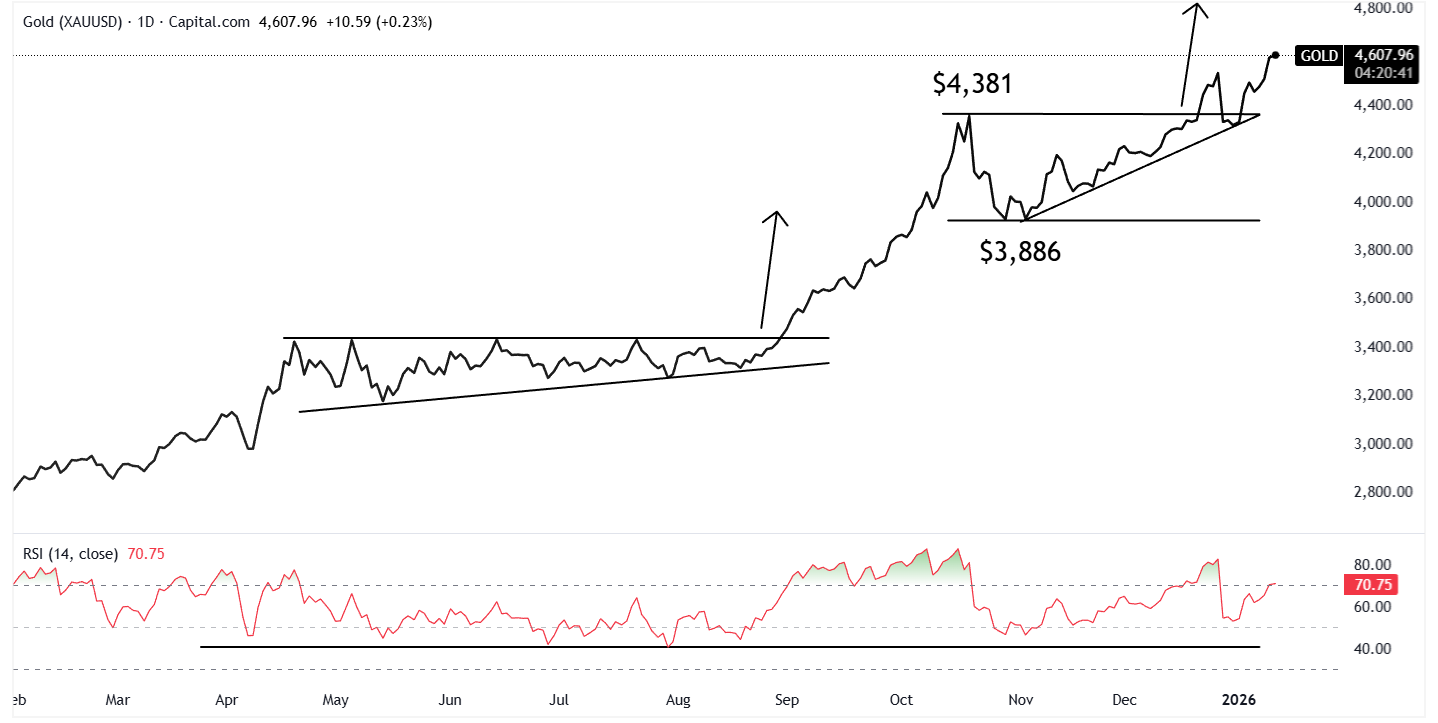
Source: TradingView. Daily gold price chart as of 13 January 2026.
Why Gold Could Reach $5,000 in 2026
The bullish momentum of gold is likely to extend further. Supportive technical momentum conditions and a bullish price structure, combined with policy uncertainty and heightened geopolitical risk, could carry prices toward $5,000 by mid-2026, and potentially to $5,200 by the end of the year.
Following the intervention in Venezuela, gold jumped nearly 2% in a single session, highlighting how sensitive prices remain to geopolitical shocks. Institutional portfolios have responded by increasing baseline gold allocations from around 5% toward 10%, reflecting gold’s growing role as a strategic asset rather than a tactical hedge.
In a scenario where economic growth slows modestly without tipping into recession, central banks may be forced to cut rates more aggressively than currently priced. Falling real yields, fading risk appetite, and a weaker dollar would create an ideal environment for gold to test new highs.
Silver and the Broader Metals Complex Join the Rally
Gold is no longer rising in isolation. Silver has emerged as the high-growth counterpart within the precious metals complex, ending 2025 up an extraordinary 166% and raising above $89 per ounce on Tuesday.
The gold-to-silver ratio has compressed from last year’s extremes but remains elevated by historical standards near 60:1. If that ratio normalises, silver could realistically shoot above $100 and reach $130 and potentially higher. China’s new export-licensing regime for silver, which now controls up to 70% of refined supply, adds a strategic supply constraint that could amplify price moves.
At the same time, base metals such as copper and aluminium remain structurally tight, reinforcing the idea that the rally extends beyond safe havens into the broader real-asset space.
Precious Metals Provide Stability in an Unstable World
The precious metals exceptional performance in 2025 appears less like a late-cycle spike and more like a sustained multi-year trend. De-dollarisation, rising debt levels, geopolitical fragmentation, and concerns over monetary credibility are not short-term phenomena, they are structural trends.
While another outsized annual gain for the precious metals complex is unlikely, the balance of risks remains skewed to the upside. In a world where political alliances are changing, fiscal pressures are mounting, and confidence in institutions is increasingly fragile, gold and silver continue to stand out as a rare source of stability.
As we move through 2026, gold and silver are unlikely to lose relevance. On the contrary, they may be entering a new phase, not as a crisis hedge, but as a core strategic allocation.
Votre capital est exposé à un risque si vous investissez. Vous pouvez perdre la totalité de votre investissement. Veuillez consulter l’avertissement complet sur les risques ici
Produits associé:

Stratégie
Covered call
Rendement des
distributions
12.10%

Stratégie
Covered Call
Rendement des
distributions
12.90%