

Author
Jonathan Hobbs, CFA
Date
12 Dec 2025
Category
Market Insights
What the Fed Rate Cut Means for Income ETP Investors
Your capital is at risk if you invest. You could lose all your investment. Please see the full risk warning here.
The US Federal Reserve cut interest rates by 0.25% on Wednesday, bringing the target range down to 3.50%–3.75%. Rate cuts affect the market and the economy – but what could it mean for exchange-traded products that sell options for income potential? Here are three things to keep in mind.
1. Rho (option price sensitivity to interest rates)
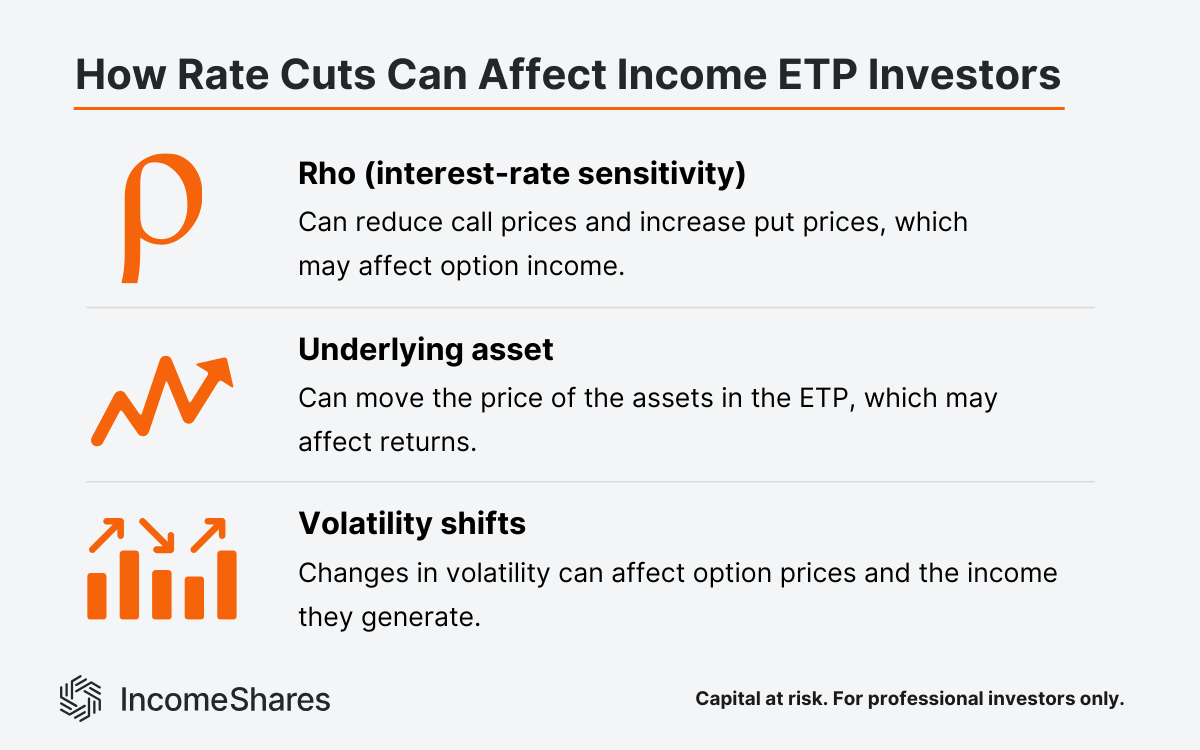
Rho is one of the option pricing inputs for the Black-Scholes model. It measures the sensitivity of an option’s price (the option premium) to interest rates. Most investors focus on other “Greeks” like Delta or Vega, but Rho still plays a part. Especially when central banks start cutting or hiking interest rates.
Black-Scholes treats interest rates as the “risk-free rate” in the option pricing equation. The model compares the value of owning an asset today with the value of owning it through an option contract. When interest rates change, so does the option value. And that can affect income potential for ETPs that sell options.
Per Black-Scholes, Rho moves call and put prices in opposite directions when interest rates fall.
Call option prices can fall: A call gives you the right to buy shares at the strike price at some point in the future. In the meantime, you can keep cash to “earn interest”. That’s different from buying a stock upfront, where you lock up that cash. When interest rates fall, the cash earns less interest. That can make it less appealing to buy call options – and reduce demand. For call-selling ETPs, that could mean slightly lower call prices when rates drop (i.e., lower income potential).
Put option prices can rise: A put works like insurance against a drop in the share price. When interest rates fall, cash earns less, so that insurance gets a bit more weight in the pricing model. That can push put option premiums up. For put-selling ETPs, that could mean slightly higher put prices when rates drop – or more income potential.
These moves tend to be small – but they can add up for income ETPs that sell options regularly. Read this article to learn more about Rho.
2. Rates can affect the value of assets held in options ETPs
Income ETPs can also hold exposure to assets like stocks, bonds, or gold. Rate cuts can move these assets, which can change the total return of the ETPs. Here’s how the Fed’s latest rate cut could affect each asset class:
Stocks don’t always rise when the Fed cuts rates. It depends on the economic situation. This wasn't a “good news” cut: job losses are rising – with US inflation still above the Fed’s 2% target. Sure, lower rates can help companies by reducing their borrowing costs, which can be good for stock prices. But if consumers have less money to spend because they’re out of work, company profit margins might take a hit. That’s typically not good for stock prices.
Gold often moves with “real rates” – interest rates minus inflation. US inflation has picked up again and is now close to 3%, while the Fed has cut the policy rate to 3.50%–3.75%. That narrows the gap between the two. When real rates fall, the “opportunity cost” of holding gold drops because cash earns less after inflation. That setup can help gold – just keep in mind that it’s already had a strong run.
Bonds tend to react the most when the Fed cuts rates. Lower rates usually pull bond yields down – and when yields fall, bond prices can rise. That could be favourable for long-dated US Treasury bonds. These tend to be more sensitive to rate changes than short-dated bonds – and could outperform if the economy weakens further.
3. Market volatility
Rate cuts can lead to changes in market volatility – and volatility is one of the biggest drivers of option prices. So far, we haven’t seen a clear move either way, with common volatility measures like the VIX staying fairly steady.
But if the economy weakens from here, markets can get more jumpy, which can lift option premiums. If things settle down instead, volatility can stay muted. Either way, it’s a lever that can influence income for option-selling ETPs after a rate cut.
IncomeShares ETPs aim to generate option income by selling call or put options. They also hold exposure to stocks, metals, or US Treasury bonds.
Key takeaways
Rate cuts can shift call and put premiums through Rho. The changes are small but can add up over time.
Stocks, gold, and bonds may react differently to this cut. Growth risks and real rates now play a bigger role.
Volatility is a major driver of option prices. It can rise or fall as the market absorbs the Fed’s move.
Your capital is at risk if you invest. You could lose all your investment. Please see the full risk warning here.
Related Products:

Strategy
Cash-Secured Put + Equity
Distribution Yield
43.74%

Strategy
Cash-Secured Put + Equity
Distribution Yield
27.34%

Strategy
Covered Call
Distribution Yield
12.88%

Strategy
Basket of Income-generating ETPs
Distribution Yield
37.44%

Strategy
Covered Call
Distribution Yield
12.35%

Strategy
Covered Call
Distribution Yield
13.15%