

Author
Violeta Todorova
Date
10 Dec 2025
Category
Market Insights
S&P 500 Outlook 2026: AI, Earnings, and Dovish Fed
Your capital is at risk if you invest. You could lose all your investment. Please see the full risk warning here.
2025 Recap: AI Took Centre Stage
In 2025, the U.S. economy was dominated by a handful of powerful structural forces, with artificial intelligence in the lead. The AI boom turned into a massive, capital-heavy investment cycle, moving at a pace few expected. Companies poured money into infrastructure, computing power, and new applications, and this wave of spending influenced nearly every corner of the market.
Because so much depended on only a few drivers, market leadership became highly concentrated, reflecting the economic reality that a small number of companies were doing most of the heavy lifting. AI was the key engine behind U.S. equity gains, even as investors debated whether valuations were running too hot and if an AI bubble is forming. History shows that big technological revolutions often bring bubbles, but they tend to inflate for some time before becoming evident.
The scale of AI-related investment was so large that company-level decisions had economy-wide effects. While potential future revenues may ultimately justify the investment surge, uncertainty persists over how much value will accrue to the companies building these AI ecosystems. Energy constraints also emerged as a limiting factor, slowing parts of the buildout but creating new opportunities across the infrastructure and utilities sectors. 2025 favoured active investing and stock-picking, particularly in identifying which firms could capture the economic upside of AI.
The financing side of the transformation was equally important. AI builders increased leverage to fund spending, while governments, already highly indebted, continued to face tensions between inflation control and debt sustainability. This combination produced a more levered and shock-sensitive financial system. Private credit and infrastructure financing played an important role.
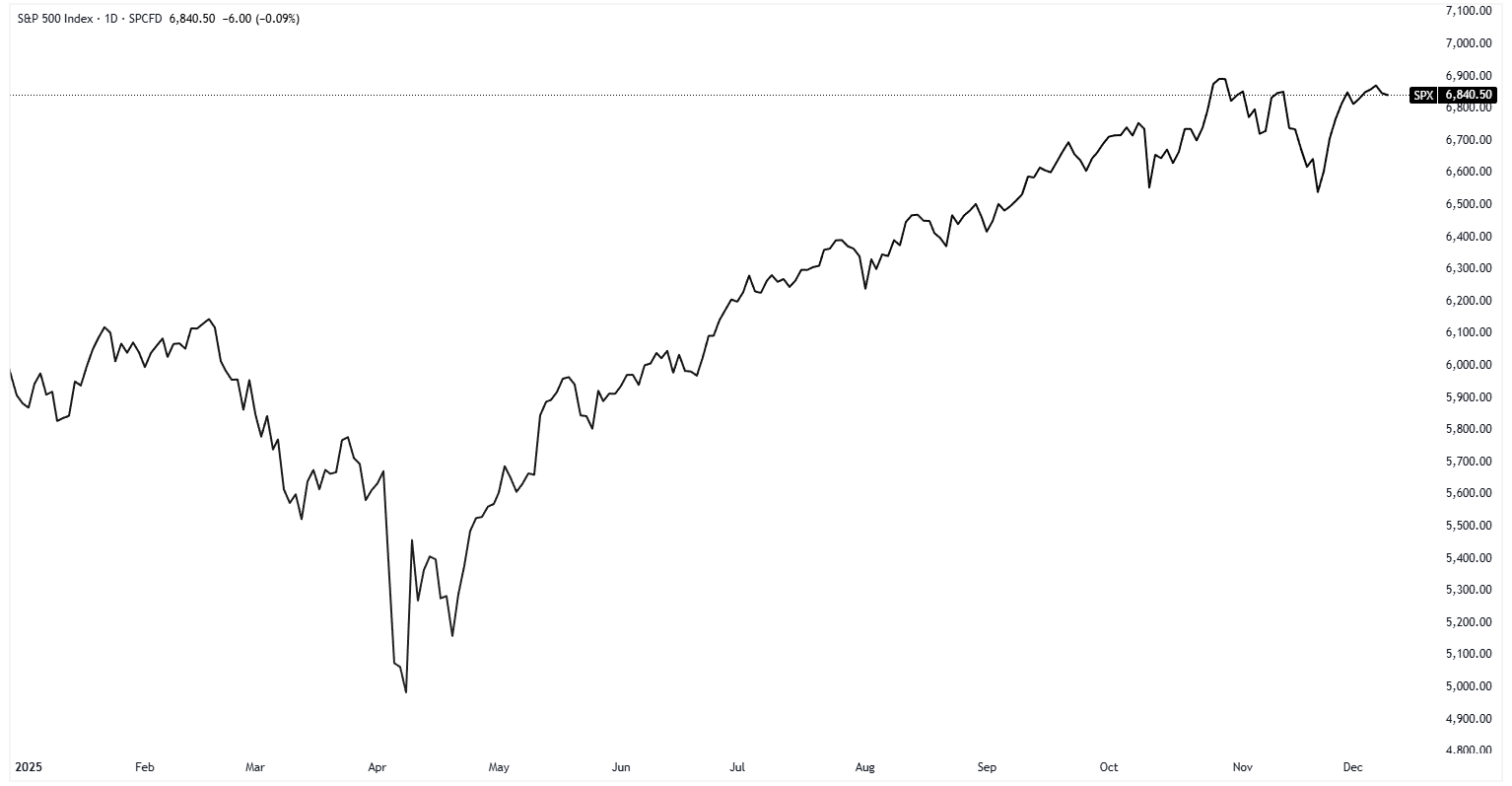
The S&P 500 heads into 2026 as an index that has consistently exceeded expectations. After months of steady gains, the benchmark is hovering near record highs, posting more than 16% returns year-to-date. Market breadth has improved, leadership is broadening out, and the rapid expansion of AI investment continues to influence both corporate behaviour and the wider global economy.
As 2025 draws to a close, the key question is how much further this rally can run in the year ahead. Our view is that equities can extend the bull market into 2026, supported by resilient earnings growth, continued investment in artificial intelligence, a more accommodative Federal Reserve, and ongoing fiscal backing.
S&P 500 Rally Broadens, Signalling a Healthier Market
December 2025 began with cautious trading and light volume as investors hesitated around extended valuations and concentration risk. But under the surface, market breadth improved, more stocks reclaimed their moving averages, and even the recent pullback held key support levels. The rally has broadened beyond a handful of mega-cap names, creating a more stable foundation as the index heads into the new year. Investor flows moved away from crowded technology trades into laggards, equal-weight indices, defensives and quality cyclical names. This rotation marks a healthier phase of the rally. Profit-taking in the largest winners is no longer a sign of exhaustion but a sign that the market is maturing and participation is widening.
Small caps, industrials and financials are also back in favour. The earnings outlook for smaller, more leveraged companies, as well as industrials, is likely to improve as the Fed reduces rates and debt servicing costs fall. After years of underperformance, earning growth for US small caps could rise to 20% in 2026. That expectation helps explain why the Russell 2000 has pushed to new highs.
Health care unexpectedly emerged as one of the strongest contributors to the year-end rally. Health care stands out as a popular contrarian idea amid a combination of low valuations and solid fundamentals, which can help the sector catch up in a positive cycle, especially in a US election year where some policy support may emerge.
Companies that benefit indirectly from artificial intelligence, for example energy and infrastructure firms that help power the data centres behind new models are also likely to perform well.
In the final weeks of 2025, the S&P 500 is just shy of its all-time closing high of 6,920, and this leg of the rally has not been driven by the usual mega-cap leaders. Instead, small caps and cyclicals are powering ahead, supported by improved earnings expectations, lower rates and falling volatility. Together, these crosscurrents are helping investors stay positioned for a constructive year-end and positive 2026 as long as the policy path does not disrupt the trend.
Fed Policy Sets the Tone for 2026
Macro sentiment has changed in late November, and surging expectations of a Federal Reserve rate cut in December propelled the S&P 500 higher. Beyond December, forecasts suggest only a gradual path of further easing. The market is expecting two more 25 basis points cuts in 2026, potentially beginning in March, as officials try to reduce the risk of a sharper slowdown in the labour market.
Powell’s leadership ends next year, and Fed leadership remains in focus as a change at the helm could meaningfully change the Fed’s policy trajectory. Expectations are rising that the administration could choose Kevin Hassett as the next Fed chair, after recent public remarks suggesting he is a serious contender, while other see Governor Christopher Waller as the steadier institutional option. Either way, investors expect a more dovish Fed chair inclined toward earlier and more aggressive rate cuts. This could provide an additional tailwind for equities, particularly interest-sensitive areas like retail and high-growth sectors.
AI Capex Boom Accelerates
2026 is set to be another strong year for AI, driven by both corporate and government spending. This surge in capital expenditure will fuel a major buildout aimed at easing ongoing infrastructure and computing constraints. AI-related companies now make up a significant share of the S&P 500’s market value, and their investments are transforming the economy from capital-light efficiency to capital-heavy innovation.
Monetization will become a central focus as companies use AI to unlock new revenue streams or reduce costs, particularly in labour-intensive sectors such as banking and pharmaceuticals, where efficiency gains remain largely untapped. More than 50% of S&P 500 firms are investing in AI, and half are already reporting measurable efficiency improvements. By late 2026, more tangible examples of AI’s impact are expected, gradually lifting margin expectations across the broader index.
Despite recurring concerns about bubbles, fundamentals remain solid. Earnings growth is strong, balance sheets are healthy, and the ongoing AI buildout is grounded in the practical need to remain competitive rather than hype. After a brief pause late in 2025, AI-related stocks have regained momentum, underlining the sector’s central role in driving U.S. equity markets.
Valuations Stretch but Fundamentals Keep Up
Valuations remain elevated, drawing comparisons to previous market bubbles. Yet this era’s leaders are established, cash-generating businesses with strong competitive positions and durable earnings power. High valuations alone do not signal a downturn. Markets typically correct when earnings falter, but at present, profit expectations for 2026 are rising. AI-driven efficiency improvements, margins expansion and rising corporate investment are helping justify valuation levels that would otherwise appear excessive. Artificial intelligence is still in an early stage, and earnings justify valuations especially in the biggest technology names.
S&P 500 Outlook for 2026 Remains Bright
Despite ongoing AI bubble and valuation concerns, elevated multiples largely reflect expectations for above-trend earnings growth, the AI capex boom, rising shareholder returns, and supportive fiscal policy. Deregulation and expanding AI-related productivity gains remain underappreciated by the market. Unlike past bubble eras, today’s leaders are established, cash-generating companies with durable earnings and strong competitive positions. Profit expectations for 2026 are rising, and AI-driven efficiency improvements, margin expansion, and continued corporate investment support current valuations, particularly among major technology names.
With broadening participation, healthier technical conditions, steady consumer demand and rapid technological investment, the S&P 500 is positioned for continued gains in 2026. We anticipate the S&P 500 to continue to move higher, driven by additional rate cuts and stable monetary policy. If inflation cools more quickly and the new Fed chair leans dovish, the possibility of the index delivering double digit gains becomes increasingly likely.
Robust earnings growth supports our positive view on U.S. equities. AI momentum is spreading across sectors, from Technology and Utilities to Banking, Health Care, and Logistics. Sentiment may remain volatile, but underlying fundamentals are solid.
For the S&P 500, we target 7,800 by the end of 2026, underpinned by solid earnings growth expectations of around 14%. Our base case assumes two more Fed rate cuts followed by an extended pause. Should the Fed ease further, higher levels appear achievable.
Professional investors seeking exposure to the S&P 500 index may consider IncomeShares S&P 500 Options (0DTE) ETPs, which provide index exposure and aim to generate monthly income through the sale of Zero Days to Expiration options.
Key Takeaways
The S&P 500 enters 2026 with broader market participation and rally support beyond mega-cap tech.
The AI supercycle accelerates earnings growth, capital spending, and industry-wide innovation.
A dovish policy and the transition to new Fed leadership support further market upside.
Your capital is at risk if you invest. You could lose all your investment. Please see the full risk warning here.
Related Products:

Strategy
Cash-Secured Put + Equity
Distribution Yield
27.14%