

Author
Jonathan Hobbs, CFA
Date
28 Feb 2025
Category
Market Insights
How Nvidia’s Revenue Has Changed In Four Years
Your capital is at risk if you invest. You could lose all your investment. Please see the full risk warning here.

Nvidia just posted another strong earnings report, but the real story is how its business model has transformed since 2020. In this blog post, we break down how Nvidia’s revenue split has shifted in the past four years – from technology diversification to AI concentration.
Nvidia’s five revenue sources
We can group Nvidia’s revenue sources into five main buckets:
1. Data center revenue: This segment sells high-performance GPUs (general processing units) to cloud providers, AI firms, and enterprises building AI data centers.
2. Gaming revenue: This segment sells GeForce GPUs for PC gaming, consoles, and cloud gaming.
3. Professional visualization revenue: Workstation GPUs for designers, engineers, and creatives. These chips power 3D rendering, video editing, and virtual reality applications.
4️. Automotive & embedded systems revenue: Nvidia provides AI chips and software for self-driving cars, driver-assistance systems, and in-car AI.
5. OEM & other revenue: A mix of legacy products, digital currency mining GPUs, and specialized chips for original equipment manufacturers (OEMs).
How Nvidia’s revenue split has changed since 2020
Gaming was Nvidia’s biggest revenue driver in Q2 of 2020, making up 51% of total sales. Data centers, by comparison, accounted for just 25%. The rest came from professional visualization (11%), automotive (8%), and OEM & other (4%).
Fast forward to today, and the mix looks completely different. Data centers now generate 90% of Nvidia’s revenue – a shift fueled by the explosion in AI.
Here’s a breakdown of how Nvidia’s revenue has changed by sector:
Data center revenue has surged from $655M per quarter in 2020 to $35.6B in Q4 2024 – a 54x increase.
Gaming revenue has grown from $1.3B per quarter to $2.5B – but its share of total sales has collapsed from 51% to just 6%.
Professional visualization, once 11% of revenue, now makes up just 1%.
Automotive revenue has grown modestly to $570M per quarter, but it remains a small slice of the business (1%).
OEM and other revenue has dropped from $257M per quarter in 2020 (4% of total revenue) to just $126M in Q4 2024 (0.3% of total revenue). This makes the business less reliant on lower-margin legacy products.
The chart below shows just how extreme this shift has been. It breaks down Nvidia’s revenue split in dollars (left) and and percentage terms (right).
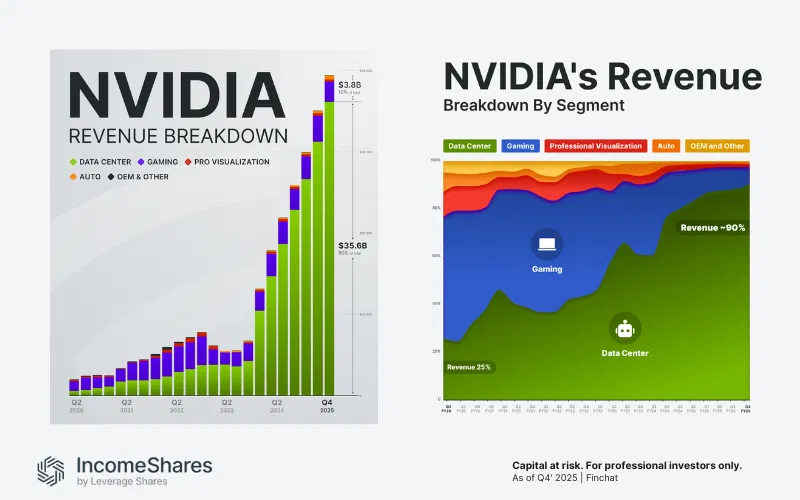
Nvidia’s business is now more concentrated in AI than ever – a major shift from its diversified revenue mix in 2020.
The IncomeShares Nvidia Options ETP seeks to generate monthly income by buying Nvidia shares and selling ‘out-of-the-money’ call options. The ETP aims to collect premiums while keeping upside exposure up to the strike price.
Key takeaways
Nvidia’s business has transformed since 2020. Data centers now make up 90% of revenue, thanks to AI demand.
Gaming and other segments still contribute, but their share of revenue has shrunk as AI has taken over.
Nvidia’s revenue streams are more concentrated than ever before.
Your capital is at risk if you invest. You could lose all your investment. Please see the full risk warning here.
Related Products:

Strategy
Cash-Secured Put + Equity
Distribution Yield
32.06%